Introduction: Why First Backpacking Trip Mistakes Beginners Make Are Worth Preventing
Backpacking has a reputation as a test of grit, and that reputation does beginners a disservice. The people who enjoy their first overnight trip are rarely the toughest or the fittest hikers on the trail; they are usually the ones who prepared before they left the parking lot. A heavy pack, a bad night’s sleep, blisters, and a dinner that never gets eaten are not badges of honor. They are the predictable result of a few habits that are easy to fix in advance and miserable to fix on a mountainside at dusk.
Most problems on a first trip trace back to a small set of avoidable decisions: carrying far more weight than the route requires, bringing gear that has never been used outdoors, planning mileage that assumes flat ground and fresh legs, and treating food, water, and weather as afterthoughts. None of these are failures of toughness. They are gaps in preparation, and each one is easier to close at your kitchen table than on the trail.
This article walks through the beginner backpacking mistakes worth avoiding, what to test before your first backpacking trip, and how to keep your pack light without leaving behind something you genuinely need. The goal is not to make you a wilderness expert before your first night out. It is to help you arrive at the trailhead with gear you trust, a plan that matches your actual pace, and a pack you can still lift on day two.
Mistake: Packing for Possibilities Instead of the Actual Trip
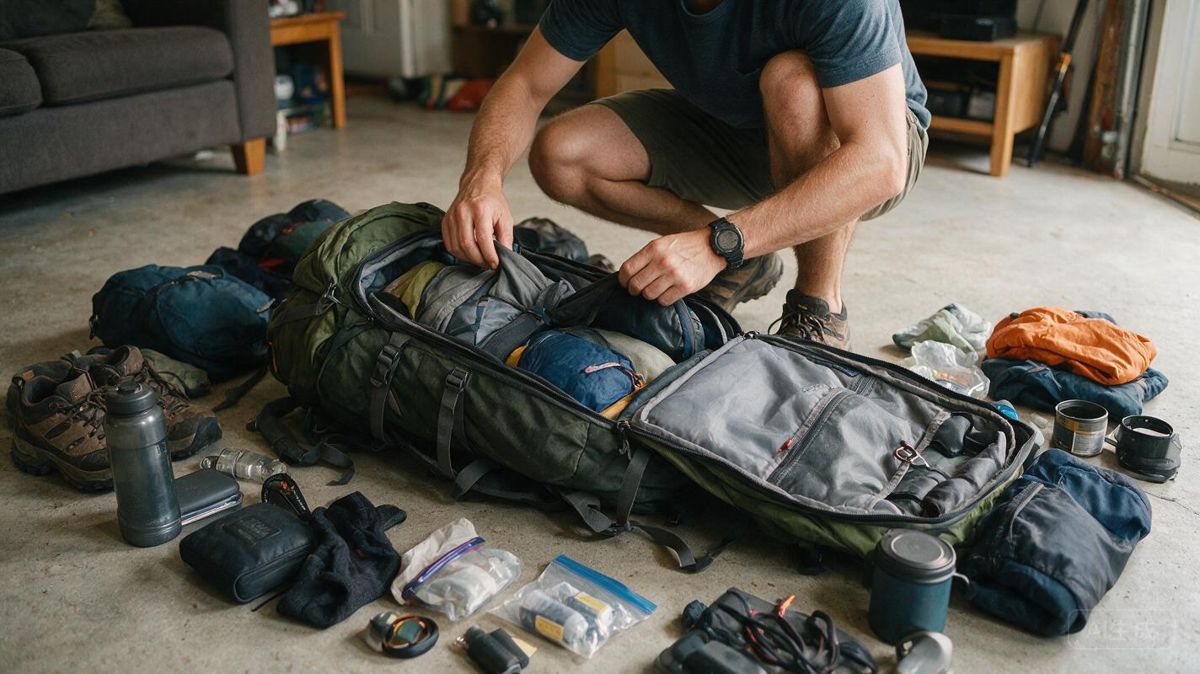
There is a particular kind of overpacking that comes from good intentions. Before a first trip, it is easy to imagine everything that could possibly go wrong or feel uncomfortable — a sudden cold snap, a blister, a long boring evening at camp, a friend who forgot something — and then to pack one item for each imagined scenario. Seen from a bedroom floor, that feels like prudence. Seen from a trail, it is usually just weight. The problem is not that the beginner was careless; it is that they packed for the union of all possible trips instead of the one they are actually taking.
Trip-specific planning starts by narrowing the question. What is the route, how long is it, and how much elevation change does it involve? What season is it, and what weather is actually typical for that time and place? Where are the reliable water sources, and how far apart are they? Those answers change what belongs in the pack far more than any general checklist does. A route with frequent water allows a smaller carrying capacity than a dry stretch does. A trip in a wet climate argues for different rain strategy than one in a dry environment where the main concern is sun exposure. And if the group is sharing a shelter, a stove, or a water treatment method, those items should be assigned to specific people before anyone leaves, so that two people are not each carrying a duplicate.
A useful habit is to replace “what if” with “what is the plan.” Contingency gear still has a place, but it should answer the realistic failure modes of this specific route and season rather than every disaster a person can picture. Anything brought “just in case” has to be carried every step of the way, and an item that never leaves the pack is dead weight that makes the parts of the trip you actually came for harder. Packing for the trip in front of you, rather than for the trip you might have taken, is what keeps a first pack honest.
How to Not Overpack for Backpacking: Build a System and Weigh It
Packing item by item almost always leads to duplicates and “just in case” extras. Instead, build four systems: sleep, kitchen, clothing, and repair. The sleep system is your shelter, sleeping bag or quilt, pad, and stakes. If your tent already includes stakes and guyline, a separate tarp and extra cord are usually redundant. The kitchen system is your stove, pot, fuel, utensil, food storage, and cleaning kit; a second pot or an extra stove only makes sense if the group has deliberately split cooking duties. The clothing system should be the layers you wear plus one dry set of socks, one insulating layer, and rain protection—not a second complete outfit. The repair system should be small: tape, a patch kit, cord, a multitool, and a spare buckle or strap. Once each system has a job, duplicates and luxury items become obvious.
Repackaging and sharing attack weight without removing real function. Take food out of boxes and combine it into a few bags, and decant toiletries into small bottles holding only the amount you expect to use. Share group gear such as a tent, stove, water filter, first-aid kit, and repair supplies, and assign each item to one person so nothing is carried twice. Then weigh the loaded pack before you leave home. Use a luggage scale or a bathroom scale, and note your base weight—the pack without food, water, and fuel. Walk around the block, climb stairs, and adjust the hip belt and shoulder straps. If something digs in, sits too high, or cannot be reached without taking the pack off, fix it at home rather than on the trail.
What to Test Before Your First Backpacking Trip: The Shakedown Trip
A shakedown trip is a short, local outing—often just one night, sometimes in a backyard or a nearby park—used to test gear and habits before a longer first backpacking trip. The point is not to cover miles or prove endurance. It is to create a low-stakes setting where failures are inconvenient rather than dangerous, and where you can adjust before the real trip.
Start with the systems you will depend on for shelter, sleep, food, and water. Pitch your shelter on uneven ground, in wind if possible, and check whether the stakes hold, the guylines are visible, and the vestibule keeps rain out when you open the door. Sleep on your pad and inside your bag or quilt using the same clothing you plan to wear, and notice whether you feel cold spots, slide off the pad, or wake up with a damp footbox. Fire up your stove to confirm you can assemble it, start it, and boil water without scorching your pot or your fingers; test it in the wind and note how long a full canister lasts under your typical use. Treat a liter of water with your filter, pump, or chemical drops to see how much effort it takes, how the flow changes as the filter clogs, and whether you have a backup method if the primary fails.
Then test the items that touch your body and guide your route. Walk several miles in your planned shoe and sock combination with a loaded pack, paying attention to hot spots, heel lift, toe bang on descents, and how wet socks feel after a stream crossing or a sweaty climb. Adjust your pack’s hip belt, shoulder straps, load lifters, and sternum strap until the weight rides on your hips rather than your shoulders, and then walk long enough to see whether anything rubs. Finally, practice navigation with the map, compass, or phone app you intend to carry: follow a short route, take a bearing, check your position, and use the tools in dim light or bad weather. A shakedown trip should leave you with a short list of repairs, replacements, and adjustments—discovered close to home, where a mistake costs an afternoon instead of derailing the trip.
Mistake: Treating Navigation, Weather, and Water as Afterthoughts
Navigation, weather, and water are the three trip elements most often postponed until the trailhead, and each one can turn a manageable day into an emergency. Start with the route itself: study the map before you leave, note the junctions and the terrain, and pick a backup option in case the intended route is flooded, snow-covered, or beyond the group’s pace. A backup can be a shorter loop, a lower-elevation alternative, or a simple out-and-back. Know where the bailout points are, because the decision to turn around is easier when you have already identified the exit. Carry a paper map and compass and know how to use them together, and if you rely on a phone, download the offline map area in advance, keep the device in airplane mode to save battery, and pack a small power bank. Signal coverage is not a navigation plan.
Weather deserves the same preparation. Check the forecast for the specific area and elevation you will be in, not the nearest town, and recheck it the morning you leave. Conditions in mountains and along coastlines can shift faster than a forecast captures, so set turnaround triggers before you start: a time by which you must reach a certain point, a cloud build-up that means descending, or a wind level that makes an exposed section unsafe. Decide in advance that turning back is a successful outcome, not a failure.
Water is the third afterthought. Identify likely sources on the map and mark them, but treat any source as uncertain, especially late in the season or after a dry spell. Carry enough capacity to reach the next reliable source, and choose a treatment method you have already tested on a shakedown trip, whether that is a filter, chemical treatment, or boiling. Finally, leave a trip plan with a responsible person: your route, expected return time, vehicle description, and who to contact if you are overdue, plus a check-in time so silence itself becomes a signal.
Mistake: Hiking Someone Else’s Pace and Neglecting Camp Routines
The urge to keep up with a faster companion can derail a first backpacking trip. Starting too fast burns energy early, and skipping breaks to stay on someone else’s schedule often leads to exhaustion, sloppy footing, and a miserable afternoon. Your sustainable pace is the speed at which you can breathe mostly through your nose and still hold a conversation. That pace will change with terrain, pack weight, and how many days you have been out. Learn it on your shakedown trip and honor it on the real one. Take short, frequent breaks—five to ten minutes every hour—to adjust layers, drink water, and eat a snack before you feel drained. If you are hiking with a group, agree to regroup at trail junctions rather than forcing everyone into a single file.
Camp routines matter just as much. Aim to arrive at camp with at least two hours of daylight. That gives you time to choose a legal campsite, set up your shelter, inflate your sleeping pad, and organize your kitchen before dusk. Fumbling with tent poles in the dark is a classic first-trip error. Once your shelter is up, secure your food. Use a bear canister, a hang, or whatever storage method is required where you are camping—never keep scented items in your tent. Leave no trace: camp on durable surfaces, pack out all trash, and keep soap and food scraps away from water sources. Finally, stay flexible. If weather turns, someone gets blisters, or you are slower than expected, adjust your plan. Turning around or stopping early is not failure; it is good judgment.
Conclusion: Turning Beginner Backpacking Mistakes to Avoid into Better Habits
The mistakes that show up on a first backpacking trip rarely say anything about who you are. They say something about what you had not yet practiced. A pack that felt fine on the living room floor turns punishing by the third mile; a route that looked short on a screen takes longer than expected; a stove that worked once at home will not light in wind. Each of those is a planning, packing, or pacing problem, and each one has a fix that carries forward to the next trip. Treating them as character flaws leads to quitting or to repeating the same trip with the same blind spots. Treating them as system problems leads to a shorter gear list, a more honest pace, and a plan with room to change.
The most useful habit after any trip is a short debrief while the details are still fresh. Write down what you used, what you never touched, where you ran out of daylight, what felt heavy, and what you would move, drop, or test before going out again. That record does more for a second trip than any shopping list, because it reflects your actual route, your actual season, and your actual body. A small notebook or a note on your phone works equally well.
From there, the improvements compound. Weight comes down as you drop items you never used. Pacing steadies as you learn what your realistic daily distance looks like on the terrain you actually walk. Navigation and water planning get faster with repetition. The beginner who finishes a first trip with sore shoulders and a late camp arrival is not a failed backpacker; that person is simply at the start of a skill that improves with every outing. Keep the trip plan, keep testing gear before you rely on it, and let each trip revise the next one.