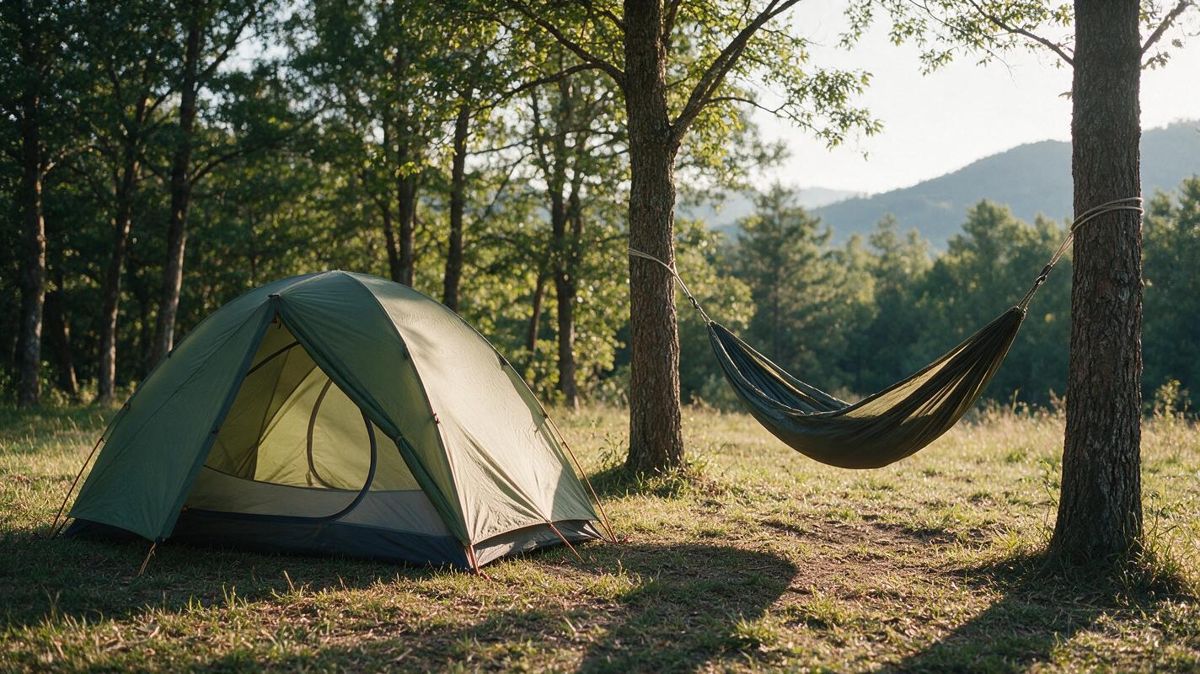
Introduction: Tent vs Hammock for Backpacking Beginners
Choosing between a tent and a hammock is one of the first real decisions a new backpacker faces, and it tends to arrive before the first trip rather than during it. Both options will keep you off the ground and out of the weather, and both can be carried for miles on your back, which is exactly why the comparison is so persistent. They solve the same basic problem — where do I sleep tonight — using two very different approaches, and each approach brings its own set of trade-offs in weight, setup, comfort, and where it can actually be used.
The reason backpackers keep comparing them is that the two systems fail in different conditions. A tent asks for a patch of relatively flat, open ground, and in exchange it gives you a self-contained shelter that works on rock, sand, snow, and above the treeline. A hammock asks for two sturdy trees spaced roughly the right distance apart, and in exchange it can turn a sloped, rocky, or brush-choked site into a comfortable night. New backpackers often assume one is simply better, but the honest answer is that the better choice depends on where you hike.
That is why this article does not hand you a single verdict. The sections that follow walk through the factors that usually decide the question in practice: the terrain and climate of the places you plan to camp, how much comfort you want at the end of a long day, whether established campsites or suitable trees are actually available where you go, and how much you are willing to learn and practice a new setup. Personal preference matters as much as any spec sheet. Read the whole comparison, weigh it against the trips you realistically plan to take, and pick the shelter that fits those trips.
How Tents and Hammocks Differ as Backpacking Shelters
A tent is a ground-based shelter, and almost everything about how it works follows from that. You clear a patch of ground, lay out the body, and use poles — either dedicated ones that come with the tent or trekking poles you already carry — to hold the shape up. Stakes and guy lines tension the whole thing so wind does not collapse it. Most tents sold for backpacking are double-wall, meaning a mesh inner body provides ventilation and a separate rainfly sheds water; a floor or a separate footprint keeps you off damp ground. A vestibule is the covered area outside the sleeping space where you stash a pack or boots. Freestanding tents can hold their shape without stakes, which helps on hard or rocky ground, while non-freestanding designs depend entirely on being staked out well. The trade is straightforward: a tent asks for reasonably flat, reasonably open, well-drained ground, and in return it gives you a fully enclosed space you can sit up in, with walls and a floor between you and the weather.
A hammock system works by suspension instead. You wrap straps around two sturdy trees and hang the hammock body between them, and because nothing touches the ground, flat terrain is irrelevant — the slope, roots, and rocks below you stop mattering. Most backpacking hammocks pair with a few separate pieces: a bug net that zips over the top, a tarp pitched overhead on its own ridgeline to shed rain and block wind, and insulation underneath. That last item is the part beginners most often miss. When you lie in a hammock, your body weight compresses the underside of a sleeping bag, so the insulation you would normally lie on loses much of its loft; hammock campers typically solve this with an underquilt that hangs beneath the hammock, or with a sleeping pad placed inside it. Set-up involves more separate adjustments than pitching a tent, and many hammockers aim for a gentle sag rather than a drum-tight hang, which takes a trip or two to get a feel for.
The practical consequences of these two designs show up in how each one handles weather, condensation, and site selection. A hammock hangs in moving air, so you feel wind and cold from below as well as above, which is why under-insulation matters so much, while a tent’s floor and walls block that airflow but tend to trap moisture from your breath, making ventilation something you manage deliberately. A tent needs one clear patch of ground; a hammock needs two anchor points of adequate size and spacing, which can be easy in forest and impossible above treeline, in open desert, or in dense scrub. Some land managers also restrict where you may hang and require wide straps to protect bark, so it is worth checking local rules before you commit to a hammock. Neither system is lighter or bulkier in the abstract — a hammock’s components add up, and a tent’s do too — so the honest comparison is between complete systems, not between a tent and a bare hammock.
Backpacking Tent vs Hammock Pros and Cons: Tent Strengths and Weaknesses
Tents earn their place in a beginner’s kit mainly by being self-contained. Once the shelter is up, you have an enclosed room: a door you can zip shut, walls that block the view of other campers, and a defined floor where your gear stays out of the dirt. That privacy matters at busy campsites, and so does the protection from ground-level insects — ants, beetles, and other crawlers are stopped by a floor and a closed door in a way that a suspended hammock, open to whatever climbs down the trees or up from below, generally is not. A tent also gives you somewhere to spread out a map, change clothes, or wait out a passing shower with your pack beside you rather than hanging it from a strap or leaving it on the ground.
The bigger advantage is where you can use it. Tents do not require trees, which makes them the more versatile choice above treeline, on alpine ridges, in deserts and canyon country, on beaches, in farm fields, and in established campgrounds where a designated pad or clear patch is what you get. A freestanding or semi-freestanding model can often be picked up and repositioned after you see how the ground drains, and it can be pitched on rock slabs or hard-packed dirt where stakes will not drive in. Many land managers also restrict or prohibit attaching anything to trees, which quietly removes hammocks from some of the places tents remain perfectly legal.
Those strengths come with real costs. A tent needs a patch of ground that is reasonably level and large enough for its footprint, and finding one in steep, brushy, or rocky terrain can take longer than beginners expect. The shelter itself — body, poles, stakes, and often a footprint — adds both weight and packed volume, and it competes for space with the rest of your gear in a pack. Condensation on the inner walls is a common annoyance in humid, still, or cold conditions, and can leave your sleeping bag damp if you brush against it. Pitching in wind and rain is the least pleasant part: stakes need something to bite into, gusts load the panels, and the inside of the tent tends to get wet while you work. Taking it down in the same weather means packing a wet shelter, which adds weight and demands drying out later.
Backpacking Tent vs Hammock Pros and Cons: Hammock Strengths and Weaknesses
Hammock camping appeals to a certain kind of beginner for reasons that have little to do with gear weight. The first is comfort: some sleepers simply sleep better in a hammock than on a pad. Back sleepers and side sleepers who dislike pressure points often find that a gathered-end hammock, pitched with enough sag to lie on the diagonal, lets them settle into a naturally curved position instead of fighting a flat surface. The gentle sway and the fact that you are not lying on the ground at all can make a difference for people who wake up stiff on a thin mat. The second advantage is site freedom: you do not need flat, level, well-drained ground. A slope, a rocky shelf, a root-filled hollow, or a damp patch all work, provided you have two solid anchor points. Third, hammocks breathe. Because air moves underneath you and around the fabric, many campers find them comfortable in warm, humid, still conditions where a tent feels stuffy. Finally, a hammock is useful before bedtime. It doubles as a seat or a place to put your feet up during a lunch stop, which a tent pitched early in the day rarely is.
The trade-offs start with the anchors themselves. A hammock needs two sturdy, living trees, spaced far enough apart to hang at a comfortable angle, and strong enough to hold a person without flexing or dropping limbs. That rules out a lot of real-world campsites: high alpine terrain above the treeline, desert country, coastal dunes, open meadows, and many established campgrounds where only tent pads or posts are provided. Even where trees exist, local land managers sometimes restrict hanging or require wide, bark-friendly straps, and a hammock’s need for two well-spaced trunks can be harder to satisfy than a tent’s need for one small patch of ground. Group camping changes too — hanging near a friend is not the same as sharing a tent site.
The other two drawbacks are gear and skill. Because your sleeping bag compresses underneath you, the insulation you rely on in a tent does almost nothing in a hammock; you need a purpose-made underquilt or a pad wide enough to stay put, which is extra kit to buy, pack, and keep dry. And hanging correctly is a skill. Suspension angle, hang height, and how much sag to build in all affect how flat you lie and how well you sleep, while the tarp overhead has to be pitched large enough and low enough to shed wind-driven rain without cooking you in still air. Beginners commonly spend the first few trips fiddling rather than resting. Add the loss of an enclosed space — no room to spread out gear, change clothes standing up, or escape bugs and weather in a sealed box — and it becomes clear that hammocks are a strong choice for some trips and conditions, not a universal upgrade.
Matching Your Shelter to Terrain, Weather, and Campsite Availability
Terrain is the first filter, and it usually narrows the choice faster than any gear comparison. Woodlands with mature, well-spaced trees suit a hammock naturally, but the same forest can be awkward for a tent if the ground is root-bound, rocky, or steeply sloped. Alpine country above the treeline inverts that relationship: a tent is the only realistic option there, because there is nothing to hang from. Desert and canyon terrain raises a different problem for hammocks, since suitable trees may be absent for long stretches or concentrated in sensitive riparian corridors where camping is discouraged. Sparse, scrubby vegetation offers no reliable anchor points at all. The practical takeaway for a beginner is to picture the specific landscape you will actually sleep in, not the average landscape of the region — tree density, trunk size, and spacing change from drainage to drainage, and a route that is wooded at the trailhead may open into bare ridges by evening.
Weather exposure shapes the decision just as much. A hammock tarp offers excellent coverage when pitched low and angled into the weather, but it depends on trees positioned to give you that angle, and exposed ridgelines and open meadows rarely cooperate. Tents handle wind differently: a well-pitched tent using stakes and guylines can be tensioned against gusts, though it depends on ground soft enough to hold those stakes. Rain introduces the question of drainage. Tents need ground that will not pool or channel water, and hammocks sidestep that concern entirely by sleeping above it — but you still have to reach and stand in the mud to get in and out. Cold, wind, and condensation behave differently in each system, and bug pressure is worth weighing too. In heavily buggy, humid conditions, a hammock with integrated netting keeps you off the ground and away from crawling insects, while a tent provides a sealed, gear-friendly enclosure that many beginners find simpler to manage at night.
Campsite availability and local rules can quietly override everything above. Where camping is limited to designated sites, those sites are typically cleared, flattish pads built for tents, and they may come with few or no trees of hangable size nearby — or with explicit rules about attaching anything to the vegetation. Regulations vary widely by land manager: some allow hammocks only with wide, tree-friendly straps, some restrict hanging in certain zones or during certain seasons, and others say nothing specific at all. Leave-no-trace practice matters here. Use broad straps rather than ropes or thin cord, avoid trees with soft or damaged bark, never hang from dead limbs, and skip the hang if the only available trees are small, fragile, or heavily used. Because rules and conditions change, the reliable move is to check with the land management agency that oversees your route before you leave, and to carry a backup plan — a shelter you can pitch on the ground, or a hammock setup that can be configured as one, keeps a single restrictive campsite from ruining a trip.
Beginner Gear, Setup, and Comfort Considerations
Comparing gear fairly means comparing complete shelter systems rather than advertised item weights. For a tent, the number that matters is the tent body plus poles, stakes, guyline, footprint or groundsheet, and any repair kit. For a hammock, it is the hammock, suspension, tree straps, a tarp with its own stakes and lines, a bug net or integrated netting, and under-insulation. When beginners add up those components, hammock setups often come out somewhat heavier and bulkier overall, but the difference depends heavily on the specific products chosen, and a minimalist hammock kit can be lighter than a large freestanding tent. Bulk matters as much as weight: hammock gear arrives as several separate bundles that pack into a longer, narrower shape, while a tent usually packs into one cylinder. Check whether your pack’s volume and shape suit either configuration before you commit.
Practice is the single most useful preparation step. Pitch the tent or hang the hammock at least once at home or in a nearby park before your first trip, then again in the rain or wind if you can do so safely. Time yourself, and note which steps you fumble. Tent users should practice staking on different surfaces and learn how seam sealing and tensioning work. Hammock users should get comfortable with suspension hardware or knots, setting a consistent hang angle, and adjusting the tarp so rain runs off rather than pooling. A setup you can complete calmly in daylight is much easier to repeat when you arrive tired at dusk.
Insulation works differently in each system, and this is where beginners most often get cold. A sleeping bag’s fill is compressed beneath you, so on the ground you rely on a pad, and under a hammock you rely on an underquilt or an insulated pad inside the hammock. Choose insulation rated for the lowest temperatures you realistically expect, and test your combination on a cool night at home before trusting it in the backcountry. Ventilation is the other comfort lever. Both systems trap moisture from your breath and body, so plan on leaving vents or doors partly open where conditions allow, and expect some condensation on cold surfaces.
Privacy and changing clothes are practical matters that seldom appear in gear reviews. A tent gives you an enclosed space to change and store gear out of sight, while a hammock generally requires a tarp pitched low and wide enough to act as a screen. On the budget side, think in categories rather than figures: entry-level kits that are heavier and less packable, mid-range gear that balances weight and cost, and premium options that save grams at a steep premium. Hammock sleepers usually buy components separately, which spreads the cost over time, while tent buyers often make one larger purchase. Used gear, borrowed setups, and rented equipment are reasonable ways to test a system before spending.
Conclusion: Tent vs Hammock for Backpacking Beginners
There is no single correct answer to the tent-versus-hammock question, and any advice that declares one shelter the winner for all beginners is oversimplifying. What actually decides the matter is the match between the shelter and the trip you are planning. A tent rewards you when you expect open, exposed, or above-treeline terrain, when you want your gear and your body inside one enclosed space, and when you would rather not depend on what happens to be growing at camp. A hammock rewards you when the route runs through wooded country with healthy, well-spaced trees, when the ground is sloped, rocky, root-bound, or damp, and when sleeping flat on the ground is the part of backpacking you like least. Both systems can be comfortable and both can be miserable; the difference usually comes down to conditions rather than brand loyalty.
The trade-offs are worth restating plainly. Tents ask for a patch of reasonably level, cleared ground and, in most designs, a little more packed weight and volume than a hammock setup aiming at the same warmth. Hammocks ask for suitable trees and for insulation underneath you, since the air moving beneath a suspended sleeper carries heat away in a way that surprises many first-timers. Hammocks also tend to demand more skill overhead — suspension angles, hang height, and a tarp pitched so it actually blocks wind-driven rain — and that skill is only built by doing it. Tents are more forgiving to learn, but pitching one in strong wind or heavy rain takes practice too.
For a beginner, the practical path is to delay the purchase. Borrow or rent a tent and a hammock before committing, and if you can, use each on the same kind of trip you expect to take. Practice setting up in daylight at home or a local park, then again in wind, and again after dark, so the process becomes routine rather than a puzzle. Take a short overnight close to a trailhead before a long trip, and pay attention to how you slept, how warm you stayed, and how much fiddling the shelter required. Then choose based on the terrain, tree cover, and weather you genuinely expect to meet, not on what someone else swears by. Many backpackers eventually own both and pick per trip, which is a perfectly reasonable place to end up.